Showing posts with label effect of oil exploration. Show all posts

Tuesday, June 30, 2009

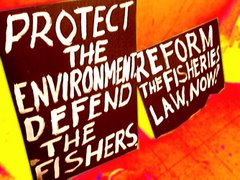
Fishermen send rotten fish to protest oil explorations


http://www.philstar.com/Article.aspx?articleId=482412&publicationSubCategoryId=107

Fishermen send rotten fish to protest oil explorations
Updated June 30, 2009 12:00 AM

CEBU, Philippines – A group of fishermen yesterday delivered rotten fish to Department of Energy Regional Director Antonio Labios to protest the oil explorations in the waters of Cebu and Bohol, which they said is the cause of the deteriorating catch in recent days.

Labios reportedly received the fish, which was placed in a brown envelope.

Isaias Angco, Vice Chairman of Pamana Sugbo, said the rotten fish symbolizes how the department is “slowly killing” the fishes and fishermen after it allowed the oil explorations in Tañon Strait and in the seas of Argao and Sibonga towns.

“Sila man unta ang naa sa authority nga mu-protektar sa kinaiyahan, sila naman hinuon ang nag-daot,” Angco said.

The fishermen who joined yesterday’s rally at DOE said their catch has reportedly decreased since the oil explorations commenced.

The group will also hold a lightning rally to cap the observance of environment month this June.

“Ang amo lang kay dili lang ta nila hilabtan ang panginabuhi sa mga mangingisda,” Angco said, adding, that they hope authorities will realize the damage the oil explorations are giving the environment and the people.

Angco said the protests will continue until the government stops the explorations.

Angco said they already sent position papers to the office of the Ombudsman and the Commission on Human Rights on the issue. — AJ A. de la Torre/JMO (THE FREEMAN)

Sunday, November 18, 2007

Negros Fact-Finding Report on Oil-exploration of Japex

FACT-FINDING MISSION REPORT

2007


Objectives


Various progressive organizations hold a fact-finding mission on several coastal communities of Guihulngan City and Vallehermoso in Negros Oriental and San Carlos City and Calatrava in Negros Occidental.


The FFM was prompted by the start of the exploration drilling to an area in the waters off the western coast of Cebu on November 10, 2007.


The exploration drilling was granted by the Environmental Management Bureau of the DENR amid the oppositions of local fisherfolks organizations PAMANA-SUGBO and PAMALAKAYA-Negros and the questions raised by environmentalist groups.


The FFM aims to document the alleged fish kills, reduction of fish catches and destructions of the “payao” during the exploration since 2005.


The FFM result will also be used in the current campaigns initiated by PAMALAKAYA and DEFEND PATRIMONY Negros to stop the oil and gas exploration in Tañon Strait.


Methodology


The team is composed of 12 members from different people’s organization. The team includes the PAMALAKAYA-Negros, PAMALAKAYA-North Negros District, PAMALAKAYA-Vallehermoso, BAYAN, GABRIELA, Aglipayan Forum, and Timbang Satellite Environmental Volunteers Organizations of Cadiz City.


The team visited 8 coastal communities from Guihulngan City, Negros Oriental northward to Calatrava, Negros Occidental. These are So. Cotcot of Barangay San Isidro, Calatrava; So. Sumulog and So. Lawis of Brgy. Buluangan, San Carlos City; So. Look Uno, Brgy. Poblacion and So. Baybay of Brgy. Pu-an, Vallerhermoso, Negros Oriental; So. Lamacan of Brgy. Malusay, So. Pier of Brgy. Bulado and So. Bocana, of Guihulngan City, Negros Oriental.


The team also visited local public officials for an interview. The team made courtesy visit to Mayor Perla Fernandez of Vallehermoso, Negros Oriental and Vice-Mayor Cesar Macaluja of Guihulngan, Negros Oriental.


Two methods were used by the Team, the Focus Group Discussions and Key Informant Interview. In FGD, A group of fisherfolks sat and shared with the FFM team to discuss the issue facilitated by the team leader. In Key Informant Interview, the team interviewed one person, who may have deeper knowledge of the issues.


The Team interviewed 15 key informants from the visited area, most of whom are municipal fisherfolks.


THE TAÑON STRAIT


The Tañon strait separates Cebu and Negros. Its peripheral provinces are Cebu, Negros Occidental and Negros Oriental. The Strait has a total coastline of 452.7 km. and a total area of 3,108.00 square kilometers. It is relatively deep with the deepest at 509 meters. Its coast is sharply sloping and fringe with reefs.


Tañon Strait is bounded with 36 coastal municipalities and cities of Cebu, Negros Occidental and Negros Oriental. Small islands and islets can be found at the central part and northern boundary of the Strait.


Patches of mangroves aggregates are found in the southern coast at both sides of Negros Oriental and Cebu. There are 188.3 sq. km. of coral reef within the strait, composed mostly fringing reef along the Negros and Cebu coastlines.


The Strait is a distinct habitat of the chambered nautilus (Nautilus pompilius, local name taklong) and a migration route of Whale sharks (Rhincodon typus). It is home to at least nine species of cetaceans, the most interesting of which are the Dwarf sperm whales (Kogia simus) and Melonheaded whale (Peponocepala electra). Thus, the strait is one of the priority areas for conservation of cetaceans and reef fishes.


The rich marine resource of Tañon Strait is the basis for the Presidential Proclamation 1234 by President Ramos on May 1998.


Tañon Strait is one of the major fishing grounds of Central Visayas and is identified as major source of squids. Based on the survey of the BFAR and the Coastal Resource Management Project (CRMP), there are about 26,850 fishers operating in the area and more than 12,000 motorized and non-motorized boats.


Tañon Strait is particularly the fishing grounds of Eastern Negros Occidental and Negros Oriental and Western Cebu. Study shows that Tañon Strait have the highest number of gillnets (kurantay (drift gillnets) Palabay (bottom gillnets), patuloy (surface-set gillnets), hooks and lines (pamasol) and squid jigs among the major fishing grounds of Central Visayas. Beach seine (sahid / baling) is also concentrated in Tañon Strait, although declared illegal is tolerated.


THE OIL EXPLORATION IN TAÑON STRAIT


In a desperate effort to achieve energy independence within 6 years under the Medium-Term Philippine Development Plan (2004-2010), the government has been awarding service contracts to various foreign oil and gas exploration company around the country. To date, there are 28 Service Contract, 1 GSEC and 9 Petroleum Energy Contracting Rounds (PERC).


In December 21, 2004 the Philippine Government awarded to JAPEX-Philippines, Inc. the Service Contract 46. The Service Contract 46 covers 2,850 square kilometers offshore of Tañon Strait covering 13 barangays in Pinamunghan and Aloguinsan towns in Cebu; 14 towns and cities in Negros Oriental and 4 towns in Negros Occidental.


JAPEX-Philippines is a 100-percent subsidiary of Japan Petroleum Exploration Co. Ltd., a leading Japanese upstream company engage in oil and natural gas exploration and production (E & P) activities both in Japan and overseas. JAPEX employs some 1,470 employees worldwide.


In May 2005, JAPEX holds a 751-kilometer multi-channel sub-bottom profiling survey using the M/S Veritas Searcher and two chase boats. It carries a 3.5 kilometer cable


Seismic surveys are used to determine the structure of underground rock formations by firing explosive charges in the ground. The intense sounds produced reflect back to a receiver to provide information about oil and gas deposits that may lie beneath the seabed.


According to local fisherfolks, the survey operates on a 24-hour basis. They could hear sounds of blasting at an interval of 5-20 seconds much like that of a thunder and as if the ship furrowing the undersea.


According to Energy Undersecretary Guillermo Balce, Tañon Strait is expected to produce 1 Billion barrels of oil. Out of this potential reserve, about 100 million barrels of oil can be recovered.


Starting November 10 this year, Japex plans to drill a hole 3,150 meters-deep in an area some 3 km west of Pinamungajan town in western Cebu. JAPEX will use the Mobile Offshore Drilling Unit (MODU), known as Hakoryu V.


If they believe that there is gas, they will set a 7" liner (steel pipe) to test the well but if gas and oil is negative, they plug the well with cement and abandon it. Another well within the contracted area will be drilled until they are certain of their data and information.


MAJOR FINDINGS


  1. FISH CATCH REDUCTION


The team confirmed the fish catch reduction after the Seismic Survey of the R/V Veritas Searcher in May 2005. The fish catch reductions continue up to this day in all areas visited by the team. The average fish catch were drastically reduced by 50-70 percent from pre-oil exploration catch of 10-15 kilos average catch per day to 2-3 kilos of fish per day.


A local fish called “baga” (bucaobucao) almost vanished in the fishing grounds off the waters of Guihulngan City after the seismic survey. Before the seismic survey, fisherfolks could produce 15-20 kilos but thereafter, they could only catch an average of 1-2 kilos.


Fisherfolks attributed the drastic reduction of the fish catch to the destruction of the “payao” or the fish aggregating device” (also called as artificial reef). The team recorded a total of 136 payao destroyed during the 2-weeks seismic survey.


According to Rene Bulado, the chairperson of the Malusay Fish Loving People, a local fisherfolks associations and serving as a leader of the Guihulngan’s City Fisherfolks Associations Management Council (C-FARMC) said that one of the three boats of the JAPEX is the one destroying the “payao” of the fisherfolks. The bewildered fisherfolks were only handed with a one-page notice right in the middle of the sea.


A payao is an artificial reef made of Styrofoam materials deployed in strategic areas. The use of payao by the local fisherfolks contributes to high fish catch. Gango o Payao is the local name for artificial corral reef and indigenuous fishing technology defined as “man-made” structures set up in marine environment to serve as shelter, source of food, and breeding ground for different fish and other organisms in the absence of the natural habitat.


Its destruction therefore has affected the fish catch of the community. Some of the payao owners were paid but some were not. In Guihulngan and in Calatrava, JAPEX paid the fisherfolks P5, 000 per payao through the intercession of the Department of Agriculture. In some areas, payao owners were paid P 4,000.00. With the exception of Calatrava, most of the areas visited by the team have not replaced the payao.


It must be pointed out that while the project proponent paid the payao owners, the most numerous yet the most affected by the seismic survey have not received compensation for almost a week of being prohibited from fishing, the marginal fisherfolks. Most fisherfolks did not dare to fish near the survey vessel for fear of being rammed or hit.


  1. FISH KILLS


Two local fisherman interviewed by the team confirmed the fish kills during the seismic survey. Of the 15 informants, three have confirmed the fish kills in their respective fishing grounds.


Marcelo Descaliar, a fisherman of Sitio Sumulog, Brgy. Buluangan, San Carlos City says that a day after the M/S Veritas Searcher zigzag the waters off their communities, at about 1 kilometer from the shoreline, the beach seine catches dead coral fishes. Fisherfolks from Guihulngan also told the team that marginal fishers have seen dead tuna on the waters.


Scientific studies have shown that “seismic blasting damages planktonic eggs and larvae found in the immediate vicinity of airguns and can reduces catches in commercial fisheries” (Dalen and Knutsen, 1985). Seismic blasting can cause behavioral modifications and reduce or eliminate available habitat for breeding / spawning, foraging and migration.


In Guihulngan, fisherfolks says that “baga” (bucaobucao in Ilonggo) almost vanished. Before the survey, Guihulngan is known as the sources of the “baga” in the province but now its almost gone.


  1. NO CONSULTATIONS WITH THE FISHING COMMUNITIES


All respondents interviewed by the team express that they have no knowledge or information of the seismic survey and the exploration drilling at Tañon Strait.


One of the fishers even though that it is an illegal fishing vessels and even call for police to apprehend but bewildered to see the escort Coast Guard. Others though that the vessel is cleaning the seabed. Only a few knows that it is a seismic survey.


All of the local public officials interviewed by the team express disappointment on the apparent lack of information drive and subsequently of the exploration drilling. They said that the national government and national government agencies should have informed and consulted them.


Since the awarding of the Service Contract in 2004, the Department of Energy and the JAPEX visits the local government only this July till October 2007. Their so-called “information drives” were attended by a few people.


Amid the dangers that the seismic survey poised to the marine environment, JAPEX never informed the concern stakeholders in the Tañon Strait, there were no consultations or even information drives before the survey were conducted.


During Seismic survey, one of the chase boats handed down one-page flyers to fishers at the sea. The said flyers are informing the fishers to stay away from the survey vessel. There are coastal communities that were never informed of the seismic survey.


The lack of consultations with all stakeholders is apparent in the absence of participations of the fisherfolks and other concerned organizations in the process to secure the Environmental Compliance Certificate (ECC). It is not simply a matter of haste in approval of the ECC but the substance of the process itself.


While the projects involved cities / municipalities of three (3) provinces, there was no public hearing or consultations conducted in Negros Occidental and Negros Oriental but in their own words “visits”.


It is worth reiterating that when we mean “environmental impacts’ it is “probable effects or consequence of proposed projects or undertakings on the physical, biological and socio-economic environment that can be direct or indirect, cumulative positive or negative”.


This might have prompted Dr. Angel Alcala of the Silliman University and a noted marine biologist to say, “IEE document wanting in the critical survey data and information needed for determining the environmental and socio-economic impacts of the proposed operation of JAPEX”.


It is only recently that the JAPEX and the Department of Energy conducts “information drives” on each of the cities and municipalities within the coverage area of their Service Contract 46. Yet, these so-called “information drives” were miserably attended by a few people, mostly local government and national line agencies employees or selected fisherfolks leaders.


Yet, the process in acquiring the ECC were called as a sham, not only because they were lacking in consultations but also with the apparent denials by government agencies of all grounds posed by fisherfolks and environmental groups against the project.


WHAT SHOULD BE DONE?


Tuesday, October 9, 2007

JAPEX ECC - COLLUSION AND DECEPTION

October 9 Press Statement of Alliance of Fisherfolk Against Off-Shore Mining, Defend our Sea Coalition, PAMANA Sugbo, Nagkahiusang Mannagat sa Tajao, Justice and Peace Center Silliman University, and FIDEC Inc.
COLLUSION AND DECEPTION

We are not surprise why the Environmental Management Bureau of the DENR under Mr. Arranguez, despite repeated request, refused to give a copy to the public the basis why the Environmental Compliance Certificate was awarded to Japan Petroleum Exploration Inc.

We are not surprise at all why the EMB is shielding JAPEX from valid questioning and despite hard scientific evidences and first-hand data, went on pursuing various destructive projects in the waters around Central Visayas.

The EMB, DOE, and JAPEX stood as doting parents in the destructive seismic activities as a prelude to an even more destructive off-shore mining in the protected seascape of Tañon Strait.

After months of assuming the role of investigators and detectives we found a document – unfortunately for us; the fisherfolks, environmental advocates, and taxpayers – we found the Initial Environmental Evaluation was used to justify the released of the ECC to Japex instead of the more thorough and comprehensive Environmental Impact Assessment and Statement.

We reviewed, evaluated, and weighed the IEE but found it wanting.

Despite scientific consensus – the proponent and their cohorts in the government will pursue drilling activities in the coming months, effectively dislocating thousands of fisherfolks, destroying our marine resources dubbed as the epicenter of global marine biodiversity, and affecting our food security.

We echo the points raised by the 1992 Ramon Magsaysay Awardee for Public Service and the present University Research Professor and Director of the Silliman University, Dr. Angel Alcala that the “IEE document wanting in the critical survey data and information needed for determining the environmental and socio-economic impacts of the proposed operation of JAPEX”

Enough of this utter Collusion and Deception, we give this marching order to various fisherfolk organizations in the region to conduct massive information campaign that will lead to mobilizing their sectors and other stakeholders as well against this project and other off-shore mining projects in the Visayas.

On the other hand we call on our national political figures to make a stand against these destructive and make urgent the house resolution calling for an investigation over off-shore mining in the Visayas. We urged them to stand against JPEPA as well, since JPEPA will serve as the backbone of the aggression of JAPEX in our waters.

We call on the Japan Bank of International Cooperation (JBIC) to withdraw its fund-support to JAPEX operation in the Philippines- your money will only increase poverty and environmental destruction in the region.

Enough of destruction and imperialist plunder. Ban Japex in Tañon Strait. Pursue Sustainable energy and use of our resources now.
Struggle for Genuine National Industrialization.

Saturday, August 18, 2007

RECALL JAPEX ECC. STOP THE PLUNDER OF OUR NATURAL RESOURCES.


Fisherfolk leaders with DOE director Engr. Labios


At the Environment Management Bureau Office with the local Media


At the office of Provincial Board Member Victo r Maambong


Below is the letter calling for a moratorium and investigation over off-shore mining in the Visayas given to the Provincial Government and the Department of Energy.

Another letter calling for the recall of JAPEX' Environmental Compliance Certificate was given to the office of the Environment Management Bureau. Currently the Provincial Vice-Governor of Cebu, the Congress, including the Philippine Senate passed resolutions calling for various actions against off-shore mining.

For a copy of the House Resolution regarding off-shore mining, please email us.

---------------------------------------------------------------------------


August 15, 2007


Atty. Victor Maambong

Provincial Board Member

Chairperson

Committee on the Environment


CALL FOR A MORATORIUM ON ALL PLANNED AND EXISTING OIL EXPLORATIONS IN THE VISAYAS


Dear Hon. Maambong,


Greetings.


The Central Visayas Fisherfolk Development Center Inc, and various organizations under DEFEND our Sea Coalition and Conservation Watch, manifests its concern on the plight of the marginal fisherfolks whose livelihood were affected by oil explorations in fact majority of Fishermen in the Visayas were not justly compensated when JAPEX and NorAsian Energy Ltd implemented their seismic survey. We would like to extend the same concern to our local marine environment deemed as one of the global centers in marine biodiversity when oil explorations and off-shore mining will commence.


According to the paper presented by DOE USEC Guillermo Balce, another 23 Service Contracts will be awarded to various corporations to conduct oil exploration activity in our waters another service contract was awarded to Forum North Cebu to conduct exploration activity, it is interesting to note that this activity will be inside made inside the Visayas Sea considered as a unique world treasure and recognized as a national heritage area.

Based on international scientific papers, seismic survey and off-shore mining will pollute our waters since Oil and Gas drilling operations generate huge amounts of waste that is discarded into water. According to the National Academy of Sciences, a single well produces between 1500 and 2000 TONS of waste material.


Debris includes drill cuttings, which is rock ground into pieces by the bit; and drilling mud brought up during the drilling process contains toxic metals such as lead, cadmium and mercury. Other pollutants, such as benzene, arsenic, zinc and other known carcinogens and radioactive materials are routinely released in “produced water,” which emerges when water is brought up from a well along with the oil or gas.


Offshore drilling will cause a significant amount of air pollution. Each offshore oil platform generates approximately 214,000 pounds of air pollutants each year(National Oceanographic & Atmospheric Administration). An average exploration well for oil or natural gasgenerates some 50 tons of nitrogen oxides (NOx), 13 tons of carbon monoxide, 6 tons of sulfur dioxide, and 5 tons of volatile organic hydrocarbons7. These pollutants are the precursors to smog, acid rain and contribute to global warming.


These projects will also spill oil to our more than the volume that destroyed Guimaras.Oil is extremely toxic to a wide variety of marine species, and current clean up methods are incapable of removing more then a small fraction of the oil spilled in marine waters. Offshore drilling platforms and pipelines spilled 1.8 million gallons of oil in U.S. waters from 1990-1999 in 224 reported accidents – that’s an average of almost 500 gallons a day.


Oil spills present the potential for enormous harm to deep ocean and coastal fishing and

fisheries. Oil waste poisons the sensitive marine and coastal organic substrate, interrupting the

food chain on which fish and sea creatures depend, and on which their reproductive success is

based. Commercial fishing enterprises may be affected permanently. Wildlife other than fish and

sea creatures, including mammals, reptiles, amphibians, and birds that live in or near the body

of water, are also poisoned by oil waste.


The hazards for wildlife include toxic effects of exposure or ingestion, injuries such as smothering and deterioration of thermal insulation, and damage to their reproductive systems and behaviors. Long-term ecological effects that contaminate or destroy the marine organic substrate and thereby interrupt the food chain are also harmful to the wildlife, so species populations may change or disappear.


During the seismic survey of JAPEX and NorAsian, a significant reduction of fish catch were

recorded, it was later found out that heavy metals contamination from seismic survey will

result to reduction of fish reproduction.(Cadmium EbrahimTi, et al. 1995 Kime, et

l. 1996, Lead - Ruby, et al. 1993, Mercury - Khun & Weis. 1987, Methylmercury - Van Look,

K. Journal of Fish Biology. 2003.)


Seismic blasting damages planktonic eggs and larvae found in the immediate vicinity of airguns (Dalen and Knutsen, 1985)‏ and can reduce catches in commercial fisheries (Slotte et al. 2004; Soldal and Loekkeborg, 1993; Engas et al. 1996; Skalski et al. 1992) since the impact of the sound underwater tends to bursts air bladders (i.e. swim bladders for fish, lungs for marine mammals and the animals may have well sunk to the ocean floor from ruptured lungs. Andrea Leonor Bautista,manager, Cetacean Research and Conservation Project - WWF. (inq7.net. Thu, Sep 08, 2005)‏ Seismic blasting can damage the hearing structures, (McCauley et al. 2003)‏ and can cause body tissues to hemorrhage (hastings, 1995)‏ and damage reproductive organs in marine organisms (Jensen and Alberdice, 1989)‏


Seismic blasting can cause behavioral modifications and reduce or eliminate available habitat for


breeding / spawning, foraging and migration (Richardson et al. 1986; Harris et al. 2001;


McCauley et al. 2000; McCauley et al. 1998)‏ Seismic noises can alter fish distribution by tens of


kilometers (Slotte et al. 2004; Engas et al. 1996)‏ It can elicit physiological stress and


neural-immune responses in Marine organisms (Santulli et al. 1998; Romano et al. 2004)

‏


Despite the damages, despite the fisherfolks were denied access to their fishing grounds fisherfolks from various communities were not justly compensated or were not compensated at all.


With this we would like to ask the your committee to issue a moratorium on all oil exploration activities and bring together all the stakeholders in a public hearing to discuss the cost and benefit of oil explorations.


We must conduct exhaustive public consultations to discuss the issues and concerns on the conduct of the oil exploration. It is noted that the consultations are limited only to “information” dissemination which is far different from the nature of a consultation where people are given enough time to engage the proponents in a healthy dialogue. Two to three hours of meeting in each of the affected municipalities are not enough compliance of the consultation requirements as provided by law.


The Local Government Code provides:


SEC. 27. Prior Consultations Required. - No project or program shall be implemented by government authorities unless the consultations mentioned in Sections 2 (c) and 26 hereof are complied with, and prior approval of the sanggunian concerned is obtained: Provided, That occupants in areas where such projects are to be implemented shall not be evicted unless appropriate relocation sites have been provided, in accordance with the provisions of the Constitution.

We are also calling on our Governor, Mayors, Sangguniang Bayan/Panlungsod, and our Congressional Representative to exercise their authority and influence to lobby with the national government to address our concerns before the actual conduct of the seismic survey.


FIDEC AND FISHERFOLK ORGANIZATIONS CALLS FOR MORATORIUM AND INVESTIGATION OVER OFF-SHORE MINING IN CENTRAL PHILIPPINES

FIDEC and various Fishermen's organization from Bohol, Argao, Dalaguete, and Pinamungajan Cebu conducted a press conference before the actual filing of legal cases against off-shore ming.


JOINT PRESS STATEMENT


RECALL JAPEX ECC. STOP THE PLUNDER OF OUR NATURAL RESOURCES.

STOP OFF-SHORE MINING IN THE VISAYAS AND THE PHILIPPINES.


It is more than a year since the oil spill tragedy in Guimaras disrupted the lives of Filipinos, It is more than a year and the culprits involved are roaming freely in Philippine waters raking profit after profit at the expense of Philippine interests.


It is more than a year and yet the government haven't learn important lessons by pursuing oil explorations in the Visayas and other parts of the Philippines. These explorations aside from violating our Constitution and Patrimony is very successful in dislocating fishermen, destroying marine biodiversity, disrupting economic activity and threatened local and global food security.


JAPEX after wreaking havoc in Tañon strait will pursue development of resources in the area this October. Despite violating the provisions of the EIA law, the Fisheries Code, the NIPAS Act, and the basic law of the land including international policies was able to secure an ECC last March 6, 2007.


The idea of energy independence flaunted by the national government and its agencies is a hoax, since the corporations involved in various oil exploration activities within Philippine waters were given the sole authority to identify, develop, and sell oil reserves from our waters.


It is quiet ironic for our country to pursue extracting finite fossil fuel deposits when the rest of the countries around us are abandoning its dependence on fossil fuel due to climate change and global warming and are now on the path of developing clean and sustainable sources of energy.


International conservation organizations, local government units,and various NGO's have spent billions of dollars protecting and sustainably developing our marine resources and yet our national government is doing the exact opposite.


Based on these there is a need to recall the questionable ECC given to JAPEX and we would like to enjoin IBP Cebu Chapter in their call to stop all planned oil explorations in the Visayas. We would like to call for a full investigation over these projects from the provincial, regional and congressional level. We also would like to call on environmental advocates, the fisherfolks, and other stakeholders to rise above the occasion and call to protect our natural resources and call for genuine national development free from foreign control and exploitation.


Let us put an end to resource plunder and environmental destruction. Let us stand up against oil exploration and off-shore mining.

-------------------


PAMANA Sugbo, DEFEND our Sea Coalition, PAMALAKAYA, Conservation Watch, Kinabuhi Inc People's Network for the Environment, FIDEC Inc.

Wednesday, June 13, 2007

Protest Action Against Offshore Mining at Dept. of Energy-Cebu

STOP OFFSHORE MINING IN THE VISAYAS!
COALITION AGAINST OFF-SHORE MINING FOR SUSTAINABLE MANAGEMENT OF MARINE RESOURCES

Defend our Sea Coalition spearheads a lightning picket protest today, June 13 at 10:00 in the morning at the office of the Department of Energy, Metrobank building, Jones Avenue, Cebu City.

The protest is directed against the planned off-shore mining exploration in Cebu Strait this coming June 15, 2007 in the seas between Bohol and Cebu.

Bohol - Conservation Watch, FIDEC's counterpart in Bohol and one of the founding members of DEFEND OUR SEA COALITION spearheads a dialogue with local government units at the same time. They will also stage a prayer rally on June 14. A boat barricade will be also organized on June 15 to 18. NorAsia Energy Limited, the company which will be conducting the oil exploration will start their payao/gango (fish pens) clearing activity to give way to a seismic survey along the Cebu-Bohol Strait on June 15.

For more reference please read the official statement below.

Fisherfolk sectors in Cebu show their opposition to offshore mining.

Offshore mining will reduce fish supply in the affected areas.


A fisherfolk leader reads the official statement condemning the Dept. of Energy and the government as 'willing apologists, partners and lackeys of destructive foreign monopoly corporation.'

A copy of the official statement issued by Defend Our Sea Coalition.

FIDEC's executive director Vince Cinches interviewed by the local media. Photos by Yowee Gonzales

Effects of Offshore Drilling

Overlooking Tañon Strait, a marine protected area under threat by Japan Petroleum Exploration Co. Ltd. (Japex). Photo by Yowee Gonzales

• A single offshore rig emits the same quantity of air pollution as 7000 cars driving 50 miles per day.
• Routine offshore drilling operations dump thousands of pounds of "drilling muds" (containing heavy metals like cadmium, chromium, arsenic, and lead) into the Gulf of Mexico. The routine pollution can cause severe disruption to marine environments and health and reproductive problems for marine mammals and fish species.

• A single exploratory well dumps approximately 25,000 tons of toxic metals into the ocean.

• A single production platform can have between 50-100 wells and can discharge 90,000 metric tons of drilling fluids, wastes, and metal cuttings into the ocean. *The Gulf of Mexico has a roughly 3000 square mile "Dead Zone" that is growing. Offshore drilling pollution, by smothering benthic (shallow water) communities, contributes to oxygen depletion and adds to the Dead Zone.

• Offshore drilling releases "toxic brines" that are pockets of water that are trapped in the geologic pockets where gas and oil occur. This toxic brine contains NORMS (naturally occurring radioactive materials), cadmium, lead, benzene, etc. The petroleum industry admits that up to 1.5 million barrels of toxic brine are discharged into the Gulf every day.

• In 1982 a 9.6 million gallon spill occurred from a storage tank of coastal Panama. This caused massive damage to seagrass beds, corals, mangroves, and coastal ecosystems much like those occurring Florida. Much of the damage from that spill continued for years, and the lasting impacts are still seen today.

Effects of Seismic Survey to Marine Life, People and the Fisherfolk Sector

The Visayan Sea is home to diverse marine life which will be greatly affected by offshore mining. Photos by Yowee Gonzales

Effects of seismic survey to marine life: fish, invertebrates, marine turtles, marine mammals - whales, whale sharks, coral reefs , and others.

A seismic survey is conducted in a particular area to quantify the amount of deposited natural gases and minerals, like oil or petroleum.

1. Seismic blasting can damage the hearing structures, (McCauley et al. 2003)
2. Cause body tissues to hemorrhage (hastings, 1995)
3. And damage reproductive organs in marine organisms (Jensen and Alberdice, 1989)
4. Seismic blasting can cause behavioral modifications and reduce or eliminate available habitat for breeding / spawning, foraging and migration (Richardson et al. 1986; Harris et al. 2001; McCauley et al. 2000; McCauley et al. 1998)
5. Seismic noises can alter fish distribution by tens of kilometers (Slotte et al. 2004; Engas et al. 1996)
6. Seismic blasting can elicit physiological stress and neural-immune responses in Marine organisms (Santulli et al. 1998; Romano et al. 2004)
7. Seismic blasting damages planktonic eggs and larvae found in the immediate vicinity of airguns (Dalen and Knutsen, 1985)
8. Seismic blasting can reduce catches in commercial fisheries (Slotte et al. 2004; Soldal and Loekkeborg, 1993; Engas et al. 1996; Skalski et al. 1992
9. The impact of the sound underwater tends to bursts air bladders (i.e. swim bladders for fish, lungs for marine mammals and the animals may have well sunk to the ocean floor from ruptured lungs. Andrea Leonor Bautista,manager, Cetacean Research and Conservation Project - WWF. (inq7.net. Thu, Sep 08, 2005)

Air pollution: Offshore natural gas drilling causes a significant amount of air pollution. Each offshore oil platform generates approximately 214,000 pounds of air pollutants each year (National Oceanographic & Atmospheric Administration).

An average exploration well for oil or natural gasgenerates some 50 tons of nitrogen oxides (NOx), 13 tons of carbon monoxide, 6 tons of sulfurdioxide, and 5 tons of volatile organic hydrocarbons7. These pollutants are the precursors to smog, acid
rain and contribute to global warming.

Water pollution: Oil and Gas drilling operations generate huge amounts of waste that is discarded intowater. According to the National Academy of Sciences, a single well produces between 1500 and 2000 TONS of waste material.

Debris includes drill cuttings, which is rock ground into pieces by the bit;and drilling mud brought up during the drilling process. This mud contains toxic metals such as lead, cadmium and mercury. Other pollutants, such as benzene, arsenic, zinc and other known carcinogens and radioactive materials are routinely released in “produced water,” which emerges when water is brought up from a well along with the oil or gas.

Oil Spills: Oil is extremely toxic to a wide variety of marine species, and current cleanup methods are incapable of removing more then a small fraction of the oil spilled in marine waters. Offshore drilling platforms and pipelines spilled 1.8 million gallons of oil in U.S. waters from 1990-1999 in 224 reported accidents – that’s an average of almost 500 gallons a day.

FIDEC Executive Director Vince Cinches in dialogue with local fisherfolk leaders in Tajao, Piamungajan, one of the affected areas along Tañon Strait. Photo by Yowee Gonzales


Unpaid gango and payao (fish pens) during the Japan Petroleum Exploration Co. Ltd. (Japex) oil exploration:

Thursday, November 30, 2006

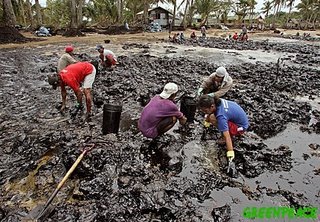
FIDEC CONDUCTS PRESS CONFERENCE ON GUIMARAS OIL SPILL LAST AUGUST 27, 2006


photo courtesy of Greenpeace

PRESS STATEMENT
MAKE PETRON ACCOUNTABLE. ALL FOR REHABILITATION.


We should not ease our campaign stand that Petron should be held accountable for the worst environmental tragedy that occurs in our water. We should put in mind that there were only 200,000 of the 2.19 million (500,000+ gallons) liters has been released to our seas and the rest of the bunker oil is a 'ticking time bomb' waiting to become our worst nightmare yet. This is a national calamity that needs action and cooperation of the entire nation, while those who are involved should be meted the harshest means possible, there is an immediate need to salvage and surface the tanker.

We condemn Petron Corporation and Sunshine Maritime Development Corporation for repeatedly ignoring international maritime restrictions in its greed for profit, and for refusing to take charge of the critical situation it has wrought. We are likewise holding the government accountable to the Filipino people for the continuing loss of livelihood and marine resources its incompetence has brought about and for allowing the ship captain to continue plying despite possessing an expired license and likewise allowing single-hulled tanker.

Petron should be made accountable for the long-term rehabilitation of the affected marine sanctuaries, mangrove areas, reefs and coastal ecosystem and that the insurance money amounting to 250 million dollars to 300 million dollars should go directly to compensation and rehabilitation of the marine ecosystem. Since more than 3,918 families made up of about 26,000 people were fisherfolk whose catch could not be sold and more than 320 kilometers of coast line, 58 hectares of seaweed, and 454 hectares of mangroves were destroyed by the oil spill.

It is disheartening and we deplore to hear that our national government doesn’t have the expertise to deal with this kind of accident – it seems that they in the government are more concern in ensuring the profiteering of oil corporations. The government must learn from this disaster and put in place policies and create specially trained response personnel to protect the marine environment and millions of Filipinos who rely on them for food and livelihood such as compelling Oil corporations to put up an Oil Spill Trust Fund.