Showing posts with label japex ecc recall. Show all posts

Saturday, October 13, 2007

Recall of Japanese Mining Company’s ECC Urged (from bulatlat.com)

Recall of Japanese Mining Company’s ECC Urged

The Central Visayas Fisherfolk Development Center together with several small fisherfolk organizations in Cebu City have reiterated a long-standing demand for the recall of the Environmental Compliance Certificate issued by the Environmental Management Bureau-Central Visayas to the Japan Petroleum Exploration Co., Ltd.

BY KARL G. OMBION
Bulatlat
Vol. VII, No. 36, October 14-20, 2007

The Central Visayas Fisherfolk Development Center (FIDEC) together with several small fisherfolk organizations in Cebu City have reiterated a long-standing demand for the recall of the Environmental Compliance Certificate (ECC) issued by the Environmental Management Bureau (EMB)-Central Visayas to the Japan Petroleum Exploration Co., Ltd. (JAPEX).

FIDEC executive director Vince Cinches, in a recent interview, said they want JAPEX’s ECC recalled because it violates the National Integrated Protected Areas System (NIPAS) Act, environmental impact assessment (EIA) laws, and the Fisheries Code of the Philippines.

The Department of Energy (DoE) Visayas Field Office recently announced that it will start oil exploration in Tanon Strait, in partnership with JAPEX, in November this year.

DoE Visayas Field Office Director Antonio Labios said they approved the JAPEX oil drilling project with a 1.5 kilometer territorial water radius in the Tanon Strait after the DENR granted it an ECC.

Areas to be affected by the oil exploration include most towns in mid-north and southwestern Cebu and on the Negros side, from Escalante City in Negros Occidental to as far as Sibulan town in Negros Oriental.

Environmental law violations

Cinches said the EMB must recall JAPEX’s ECC because of the company’s failure to conduct public hearings and consultations and other similar activities to present its environmental impact statement (EIS) for proper appreciation – a requirement, he said, since the EIA should study the ecological, geophysical and socio-economic impacts of the preparatory, operational and decommissioning phases of the activity.

Cinches cited Sec. 9 of Presidential Decree No. 1586, or the decree establishing an EIS System, which states that:

“Any person, corporation or partnership found violating Section 4 of this Decree, or terms and conditions in the issuance of the Environmental Protection Council pursuant to this Decree shall be punished by the suspension or cancellation of his/its certificate or and/or a fine in an amount not to exceed Fifty Thousand Pesos (50,000.00) for every violation thereof, at the discretion of the National Environmental Protection Council.”

The conduct of an EIA is a requirement under Philippine law. Sec. 4 of Presidential Decree No. 1151, or Philippine Environmental Policy, provides that “all agencies and instrumentalities of the national government, including government-owned or controlled corporations, as well as private corporations, firms and entities shall prepare, file and include in every action, project or undertaking which significantly affects the quality of the environment a detailed statement on:

“a. the environmental impact of the proposed action, project or undertaking;

“b. any adverse environmental effect which cannot be avoided should the proposal be implemented;

“c. alternative to the proposed action;

“d. a determination that the short-term uses of the resources of the environment are consistent with the maintenance and enhancement of the long-term productivity of the same; and

“e. whenever a proposal involves the use of depletable or nonrenewable resources, a finding must be made that such use and commitment are warranted.

Cinches also said that the DOE and EMB violated the NIPAS Law. “We note that the project is part (of) and within the Tanon Strait, (a) protected seascape under Presidential Decree No. 1234,” he said. “As such, the activity will also be governed by Republic Act No.7586, the National Integrated Protected Areas System (NIPAS) Act.”

Section 20 of the NIPAS Act provides that “except as may be allowed by the nature of their categories and pursuant to rules and regulations governing the same, the following acts are prohibited within protected areas:

“(a) Hunting, destroying, disturbing, or mere possession of any plants or animals or products derived therefrom without a permit from the protected area management board;

“(b) Dumping of any waste products detrimental to the protected area, or to the plants and animals or inhabitants therein;

“(c) Constructing or maintaining any kind of structure fences or enclosures, conducting any business enterprise without a permit.”

Section 12 of the NIPAS Act further provides that:

“Proposals for activities which are outside the scope of the management plan for protected areas shall be subject to an environmental impact assessment as required by law before they are adopted, and the results thereof shall be taken into consideration in the decision making process. No actual implementation of such activities shall be allowed without the required ECC under the Philippine EIA system…”

Aside from violating the EIA laws and the NIPAS Act, Cinches said, JAPEX’s ECC also violates the Fisheries Code of the Philippines which protects the municipal waters – in this case the waters of Toledo City, Pinamungahan and Aloguinsan towns in Tanon Strait’s Cebu side, and Guihulngan and Vallehomoso towns in the Negros side – from the intrusion of offshore mining projects.

“This kind of project destroys the marine biodiversity, fish stocks, water pollution, air pollution, oil spills, and worse, the deprivation of small artisan fisherfolk from their main sources of livelihood,” Cinches said.

“We condemned DoE for pursuing the project despite evidences gathered during our environmental investigative mission (EIM) that the seismic survey conducted (in) 2005 has resulted in dramatic reduction of fish catch, also it resulted in fish kill, and health problems in the southwestern part of Cebu, particularly Toledo, Pinamungajan, and Aloguinsan,” he added. “Tourism activities such as dolphin watching and diving (in Bais and Cebu) were affected.”

He said that two years after their EIM, various marine species have yet to return for the season and fish catch continues to decline especially in Pinamungajan, Aloguinsan and Vallehermoso.

He slammed EMB for withholding related documents such as EIS, EIA and other bases for granting an ECC to JAPEX despite repeated formal requests from their office.

He however said that a copy of the said ECC which they got from former Environment Secretary Angel Alcala revealed that the DoE and EMB had only done initial environmental examination (IEE) of the impact of the project and not the complete and thorough EIS and EIA. “This is a serious deception and should be penalized,” he said.

In a separate statement, Alcala – who now heads Silliman University’s Angelo King Center for Research and Environmental Management – said the DoE and EMB’s survey of Tanon Strait “was extremely rapid, lacking in critical data essential for valid and meaningful comparisons in order to determine the impacts of the exploratory drilling.”

“It is clear that DoE and EMB are in cahoots with various environmentally destructive corporations when they decided to push through with seismic surveys last year,” Cinches said. “They are pushing for marine rehabilitation and protection while pursuing offshore mining.”

Socio-environmental costs

Cinches reiterated his group’s stand that offshore mining should be banned in the Visayas since the activity “will have great repercussions on marine supply, food security, local economy, and will dislocate thousands of already impoverished fisherfolk.”

Cinches also said that offshore mining “will strengthen the control of foreign monopoly corporations over our resources, since the service contract awarded to JAPEX will allow them 100-percent ownership and control on prospecting, mine development, and extraction.”

Cinches said that they are mobilizing the broadest network possible to resist and halt the JAPEX-DoE oil drilling in Tanon Strait. Bulatlat

( categories: )

Saturday, August 18, 2007

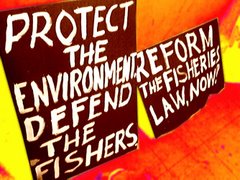
RECALL JAPEX ECC. STOP THE PLUNDER OF OUR NATURAL RESOURCES.


Fisherfolk leaders with DOE director Engr. Labios


At the Environment Management Bureau Office with the local Media


At the office of Provincial Board Member Victo r Maambong


Below is the letter calling for a moratorium and investigation over off-shore mining in the Visayas given to the Provincial Government and the Department of Energy.

Another letter calling for the recall of JAPEX' Environmental Compliance Certificate was given to the office of the Environment Management Bureau. Currently the Provincial Vice-Governor of Cebu, the Congress, including the Philippine Senate passed resolutions calling for various actions against off-shore mining.

For a copy of the House Resolution regarding off-shore mining, please email us.

---------------------------------------------------------------------------


August 15, 2007


Atty. Victor Maambong

Provincial Board Member

Chairperson

Committee on the Environment


CALL FOR A MORATORIUM ON ALL PLANNED AND EXISTING OIL EXPLORATIONS IN THE VISAYAS


Dear Hon. Maambong,


Greetings.


The Central Visayas Fisherfolk Development Center Inc, and various organizations under DEFEND our Sea Coalition and Conservation Watch, manifests its concern on the plight of the marginal fisherfolks whose livelihood were affected by oil explorations in fact majority of Fishermen in the Visayas were not justly compensated when JAPEX and NorAsian Energy Ltd implemented their seismic survey. We would like to extend the same concern to our local marine environment deemed as one of the global centers in marine biodiversity when oil explorations and off-shore mining will commence.


According to the paper presented by DOE USEC Guillermo Balce, another 23 Service Contracts will be awarded to various corporations to conduct oil exploration activity in our waters another service contract was awarded to Forum North Cebu to conduct exploration activity, it is interesting to note that this activity will be inside made inside the Visayas Sea considered as a unique world treasure and recognized as a national heritage area.

Based on international scientific papers, seismic survey and off-shore mining will pollute our waters since Oil and Gas drilling operations generate huge amounts of waste that is discarded into water. According to the National Academy of Sciences, a single well produces between 1500 and 2000 TONS of waste material.


Debris includes drill cuttings, which is rock ground into pieces by the bit; and drilling mud brought up during the drilling process contains toxic metals such as lead, cadmium and mercury. Other pollutants, such as benzene, arsenic, zinc and other known carcinogens and radioactive materials are routinely released in “produced water,” which emerges when water is brought up from a well along with the oil or gas.


Offshore drilling will cause a significant amount of air pollution. Each offshore oil platform generates approximately 214,000 pounds of air pollutants each year(National Oceanographic & Atmospheric Administration). An average exploration well for oil or natural gasgenerates some 50 tons of nitrogen oxides (NOx), 13 tons of carbon monoxide, 6 tons of sulfur dioxide, and 5 tons of volatile organic hydrocarbons7. These pollutants are the precursors to smog, acid rain and contribute to global warming.


These projects will also spill oil to our more than the volume that destroyed Guimaras.Oil is extremely toxic to a wide variety of marine species, and current clean up methods are incapable of removing more then a small fraction of the oil spilled in marine waters. Offshore drilling platforms and pipelines spilled 1.8 million gallons of oil in U.S. waters from 1990-1999 in 224 reported accidents – that’s an average of almost 500 gallons a day.


Oil spills present the potential for enormous harm to deep ocean and coastal fishing and

fisheries. Oil waste poisons the sensitive marine and coastal organic substrate, interrupting the

food chain on which fish and sea creatures depend, and on which their reproductive success is

based. Commercial fishing enterprises may be affected permanently. Wildlife other than fish and

sea creatures, including mammals, reptiles, amphibians, and birds that live in or near the body

of water, are also poisoned by oil waste.


The hazards for wildlife include toxic effects of exposure or ingestion, injuries such as smothering and deterioration of thermal insulation, and damage to their reproductive systems and behaviors. Long-term ecological effects that contaminate or destroy the marine organic substrate and thereby interrupt the food chain are also harmful to the wildlife, so species populations may change or disappear.


During the seismic survey of JAPEX and NorAsian, a significant reduction of fish catch were

recorded, it was later found out that heavy metals contamination from seismic survey will

result to reduction of fish reproduction.(Cadmium EbrahimTi, et al. 1995 Kime, et

l. 1996, Lead - Ruby, et al. 1993, Mercury - Khun & Weis. 1987, Methylmercury - Van Look,

K. Journal of Fish Biology. 2003.)


Seismic blasting damages planktonic eggs and larvae found in the immediate vicinity of airguns (Dalen and Knutsen, 1985)‏ and can reduce catches in commercial fisheries (Slotte et al. 2004; Soldal and Loekkeborg, 1993; Engas et al. 1996; Skalski et al. 1992) since the impact of the sound underwater tends to bursts air bladders (i.e. swim bladders for fish, lungs for marine mammals and the animals may have well sunk to the ocean floor from ruptured lungs. Andrea Leonor Bautista,manager, Cetacean Research and Conservation Project - WWF. (inq7.net. Thu, Sep 08, 2005)‏ Seismic blasting can damage the hearing structures, (McCauley et al. 2003)‏ and can cause body tissues to hemorrhage (hastings, 1995)‏ and damage reproductive organs in marine organisms (Jensen and Alberdice, 1989)‏


Seismic blasting can cause behavioral modifications and reduce or eliminate available habitat for


breeding / spawning, foraging and migration (Richardson et al. 1986; Harris et al. 2001;


McCauley et al. 2000; McCauley et al. 1998)‏ Seismic noises can alter fish distribution by tens of


kilometers (Slotte et al. 2004; Engas et al. 1996)‏ It can elicit physiological stress and


neural-immune responses in Marine organisms (Santulli et al. 1998; Romano et al. 2004)

‏


Despite the damages, despite the fisherfolks were denied access to their fishing grounds fisherfolks from various communities were not justly compensated or were not compensated at all.


With this we would like to ask the your committee to issue a moratorium on all oil exploration activities and bring together all the stakeholders in a public hearing to discuss the cost and benefit of oil explorations.


We must conduct exhaustive public consultations to discuss the issues and concerns on the conduct of the oil exploration. It is noted that the consultations are limited only to “information” dissemination which is far different from the nature of a consultation where people are given enough time to engage the proponents in a healthy dialogue. Two to three hours of meeting in each of the affected municipalities are not enough compliance of the consultation requirements as provided by law.


The Local Government Code provides:


SEC. 27. Prior Consultations Required. - No project or program shall be implemented by government authorities unless the consultations mentioned in Sections 2 (c) and 26 hereof are complied with, and prior approval of the sanggunian concerned is obtained: Provided, That occupants in areas where such projects are to be implemented shall not be evicted unless appropriate relocation sites have been provided, in accordance with the provisions of the Constitution.

We are also calling on our Governor, Mayors, Sangguniang Bayan/Panlungsod, and our Congressional Representative to exercise their authority and influence to lobby with the national government to address our concerns before the actual conduct of the seismic survey.


FIDEC AND FISHERFOLK ORGANIZATIONS CALLS FOR MORATORIUM AND INVESTIGATION OVER OFF-SHORE MINING IN CENTRAL PHILIPPINES

FIDEC and various Fishermen's organization from Bohol, Argao, Dalaguete, and Pinamungajan Cebu conducted a press conference before the actual filing of legal cases against off-shore ming.


JOINT PRESS STATEMENT


RECALL JAPEX ECC. STOP THE PLUNDER OF OUR NATURAL RESOURCES.

STOP OFF-SHORE MINING IN THE VISAYAS AND THE PHILIPPINES.


It is more than a year since the oil spill tragedy in Guimaras disrupted the lives of Filipinos, It is more than a year and the culprits involved are roaming freely in Philippine waters raking profit after profit at the expense of Philippine interests.


It is more than a year and yet the government haven't learn important lessons by pursuing oil explorations in the Visayas and other parts of the Philippines. These explorations aside from violating our Constitution and Patrimony is very successful in dislocating fishermen, destroying marine biodiversity, disrupting economic activity and threatened local and global food security.


JAPEX after wreaking havoc in Tañon strait will pursue development of resources in the area this October. Despite violating the provisions of the EIA law, the Fisheries Code, the NIPAS Act, and the basic law of the land including international policies was able to secure an ECC last March 6, 2007.


The idea of energy independence flaunted by the national government and its agencies is a hoax, since the corporations involved in various oil exploration activities within Philippine waters were given the sole authority to identify, develop, and sell oil reserves from our waters.


It is quiet ironic for our country to pursue extracting finite fossil fuel deposits when the rest of the countries around us are abandoning its dependence on fossil fuel due to climate change and global warming and are now on the path of developing clean and sustainable sources of energy.


International conservation organizations, local government units,and various NGO's have spent billions of dollars protecting and sustainably developing our marine resources and yet our national government is doing the exact opposite.


Based on these there is a need to recall the questionable ECC given to JAPEX and we would like to enjoin IBP Cebu Chapter in their call to stop all planned oil explorations in the Visayas. We would like to call for a full investigation over these projects from the provincial, regional and congressional level. We also would like to call on environmental advocates, the fisherfolks, and other stakeholders to rise above the occasion and call to protect our natural resources and call for genuine national development free from foreign control and exploitation.


Let us put an end to resource plunder and environmental destruction. Let us stand up against oil exploration and off-shore mining.

-------------------


PAMANA Sugbo, DEFEND our Sea Coalition, PAMALAKAYA, Conservation Watch, Kinabuhi Inc People's Network for the Environment, FIDEC Inc.